

What to Look for in a Wholesale Coffee Supplier
What should you look for in a wholesale coffee supplier?
Look for a supplier who prints a roast date on every bag, delivers on a schedule matched to how much coffee you actually use, cups consistently batch to batch, answers the phone when something goes wrong, and puts clear terms in writing. Price matters. It is not the first thing.
Almost every wholesale headache traces back to one of those five, and all five are answerable in the first conversation. Most buyers never ask, because the price sheet looked fine.
Here is the checklist we would hand a café owner, including the questions where we would lose the bid. If you need cups, syrups, pastries, and coffee on one invoice, a distributor fits better than we do. If you run 40 locations across nine states, a national supplier has infrastructure we do not.
- Freshness you can verify, not freshness you are told about
- Consistency you can taste across weeks, not one great sample
- Support that shows up when a shot is off or a delivery is late
- Pricing you can actually compare, which is never just price per pound
- Terms you can exit without a penalty you did not see coming
Are you buying from a wholesale coffee roaster or a distributor?
A wholesale coffee roaster roasts the coffee and controls the roast date, the roast profile, and the sourcing. A distributor buys finished product from roasters and other manufacturers and resells it alongside cups, syrups, and food. Roasters win on freshness and coffee expertise. Distributors win on catalog breadth and one-stop convenience.
The difference shows up on a bad day. When a batch tastes off, a roaster can tell you what changed: a new crop landed, the profile moved, the coffee is younger than usual. A distributor can tell you what shipped. Both answers are honest. Only one of them fixes your espresso. Freshness works the same way, because a roaster roasts to order while a distributor holds inventory.
Plenty of good shops use both. We work with a distributor ourselves and will name them, because the referral is real. Espresso Products Direct in Lacey, Washington has supplied Western Washington cafés since 2004: cups, lids, syrups and sauces, blended mixes, energy drinks, baked goods. We have worked with them for more than a decade and we deliver to them weekly, so their coffee is not warehouse stock aging on a pallet. If you want one invoice for supplies and you are in Western Washington, they are a good call.
So it is not roaster good, distributor bad. It is knowing which one owns the answer when something breaks.
What should you ask before signing a wholesale coffee contract?
Ask about the order minimum, lead time and weekly order cutoff, whether a roast date is printed on every bag, what happens when a coffee is discontinued mid-season, how much notice you get before a price change, payment terms, contract length, exclusivity, and exactly how to leave. Get the answers in writing.
- Order minimum and lead time. The delivery minimum, the price-tier minimum, and days from order to dock are three separate numbers.
- Roast date on the bag. Printed, every bag, every delivery. Not available on request.
- Substitutions. Ask what goes in your hopper when your house coffee runs out, and whether they tell you first.
- Price-change notice. Thirty days in writing is reasonable. A surprise on the invoice is not.
- Payment terms. Net 15, net 30, card on file, and what happens if you are late once.
- Contract length and exit. Term, notice period, early-exit fee, and whether equipment is tied to the deal.
- Exclusivity. Some agreements quietly block you from carrying a guest roaster.
- Who your actual contact is. A name and a cell number beats a support address.
A supplier who answers all of that quickly has answered it before. One who gets vague on two of them has told you where your problems will be.
How should a wholesale supplier handle freshness and delivery?

Coffee should reach you inside the 7 to 30 day window off roast, on a delivery schedule built around your weekly usage rather than your storage shelf. Every wholesale bag should carry a roasted-on date so you can rotate stock. A warehouse full of coffee is inventory, not freshness.
The seven day floor is gas, not preference. Fresh coffee is still releasing carbon dioxide, and under espresso pressure that makes the puck churn so water channels instead of soaking through evenly. We went deeper on that in how long coffee stays fresh after roast.
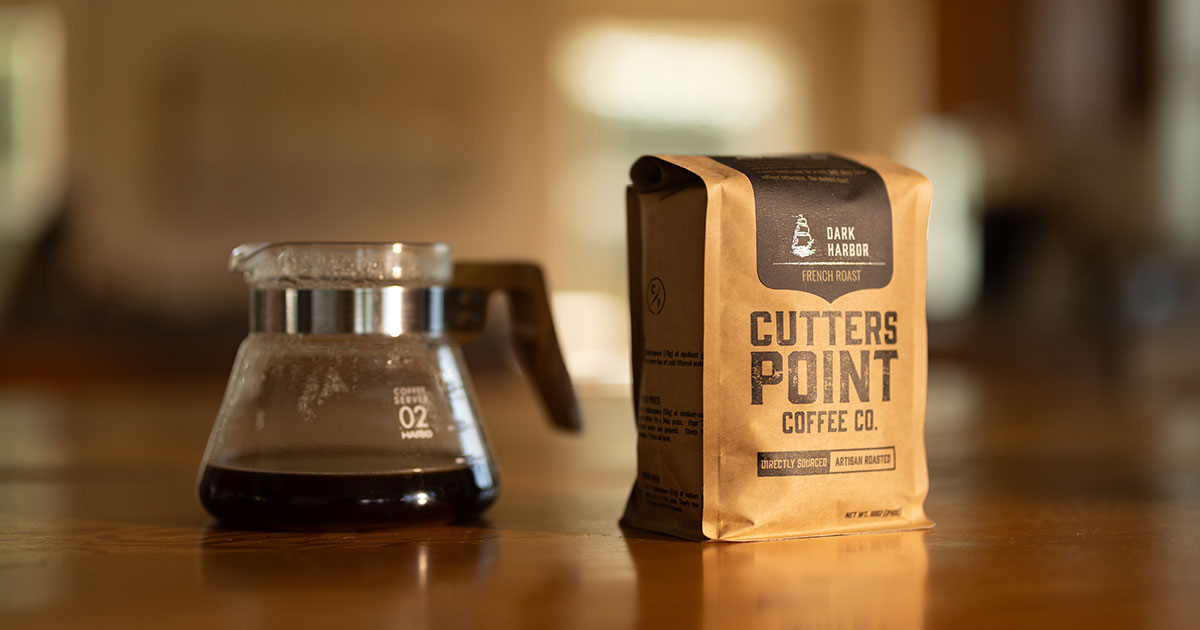
Here is where dating gets confusing, so we will be specific about our own bags. Every wholesale bag we ship carries a roasted-on date. Our 12 ounce Cutters Point retail bags carry a best-by date set one year from roast, because that is what grocery shelves require. If your supplier prints only a best-by, you cannot rotate stock by age, and you cannot tell whether a flat batch was a roasting problem or a four-month-old bag.
Cadence should follow usage. If you go through 20 pounds a week, you want 20 pounds a week, not 60 every third week so somebody can hit a freight minimum. Then ask what emergency fulfillment looks like, because a carrier delay or a weekend that sells double is coming eventually.
What does consistency actually require from a roaster?

Consistency comes from repeatable equipment, controlled batch sizes, documented roast profiles, and green coffee bought with the next season in mind. Ask what the roaster runs, how large the batches are, how each one is checked, and what happens when an origin changes. Small batch on its own means nothing.
Here is what that looks like on our side. We roast on a Diedrich CR-70 in Gig Harbor, Washington, at about 118 pounds per batch, moving roughly 10,000 to 15,000 pounds a week. Batch size stays consistent on purpose, because changing it changes the roast. We track development on every batch, we manage weight loss on every roast, and we cup against a reference before anything ships.
Food safety belongs here too, since you are putting our product in front of your customers. Our production team includes PCQI-certified staff, and we carry a third-party audit through Costco that we scored 100% on most recently. Ask any roaster what audits they hold and when they last passed one.
Green coffee is the other half. We buy from Brazil, Colombia, Peru, Honduras, Nicaragua, Guatemala, Ethiopia, and Indonesia, and our decaf is Swiss Water Process, which pulls caffeine with water instead of chemical solvents. Decaf is where the gap between roasters is widest.
We have been roasting in the Pacific Northwest since 1995, supplying cafés, restaurants, offices, and grocers here and nationwide. Whatever a roaster tells you, test it on your own machine, with your water, during a real rush.
What support should you expect beyond the beans?
Expect barista training for your team, grind and recipe setup on your own equipment, help building the drink menu, and a real person to call during a quality issue. That support is worth more than a few cents a pound, because it lands on labor, waste, and how your coffee tastes at 7am.
Training is the line buyers undervalue. A barista taught to read a bad shot and dial a grinder wastes less product than one who learned by watching. We put roughly 100 hours into a new barista before they run a bar alone, and we build that same program into wholesale accounts.
Dial-in help matters because your equipment is not our equipment. In our cafés we run La Marzocco Swift grinders, which dose and tamp automatically and remove two of the largest sources of shot-to-shot variation. On a different grinder the numbers change, and a supplier who sets your grind, dose, and yield on your machine saves your team a week of guessing every time a bag changes. We usually start new accounts on Discovery Espresso, because it is forgiving to dial in and holds up in milk.
Then ask what happens on the bad day: a bag that tastes wrong, a grinder that drifted, a delivery that never landed. You want a name and a phone number, not a contact form.
How should you compare wholesale coffee pricing?
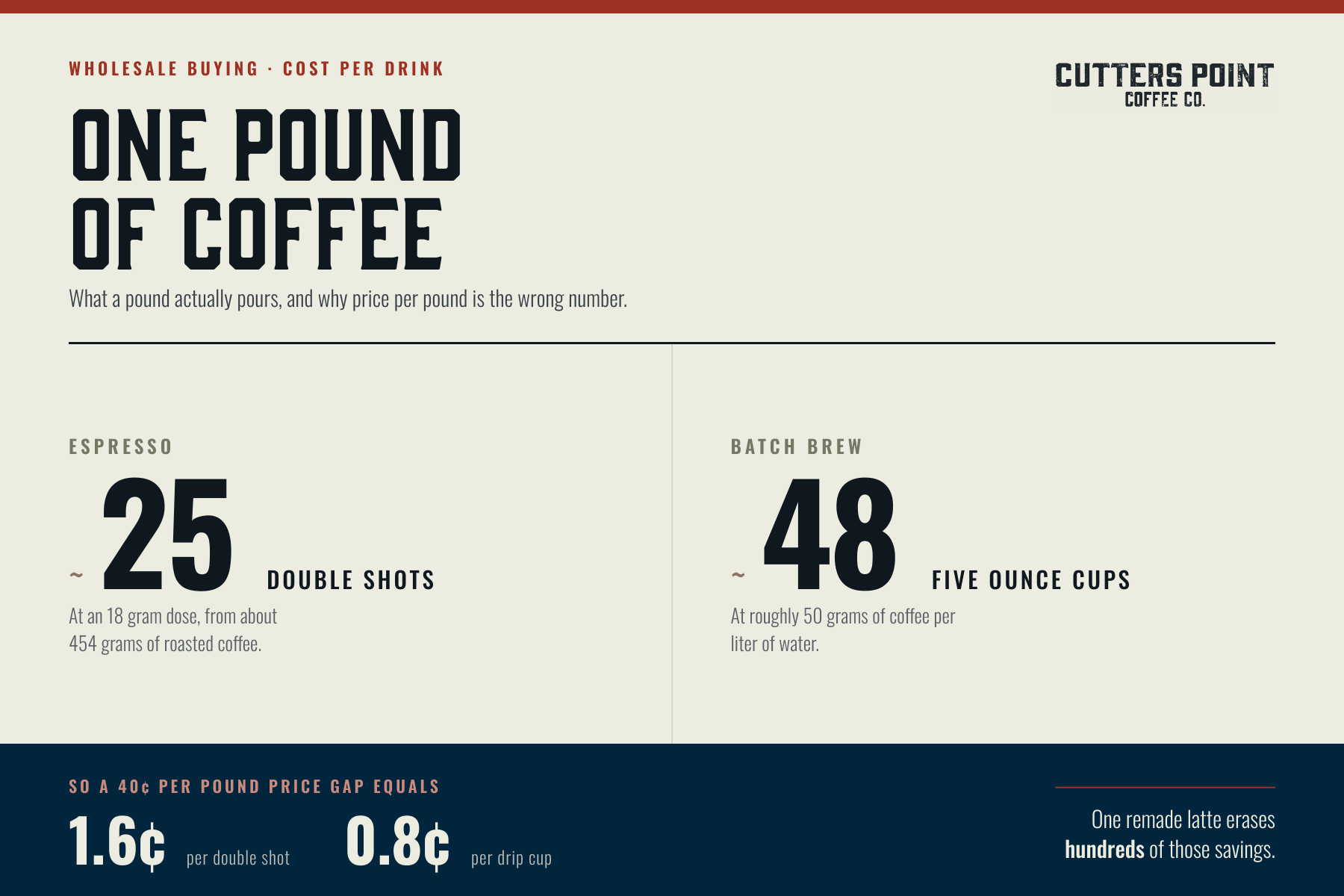
Compare wholesale coffee on cost per drink, not cost per pound. A pound of coffee makes roughly 25 double shots of espresso or about 48 five-ounce cups of drip, so a 40-cent difference in pound price works out to under two cents per drink. That is real money at volume, but it is smaller than what you lose to inconsistent coffee, remade drinks, and stale inventory.
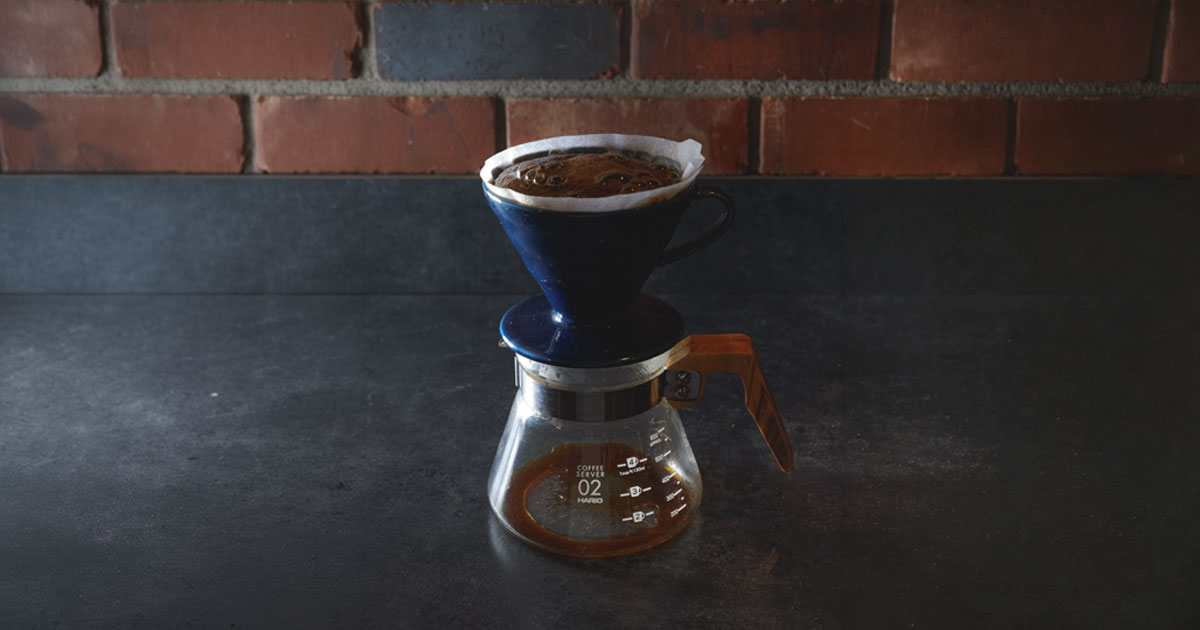
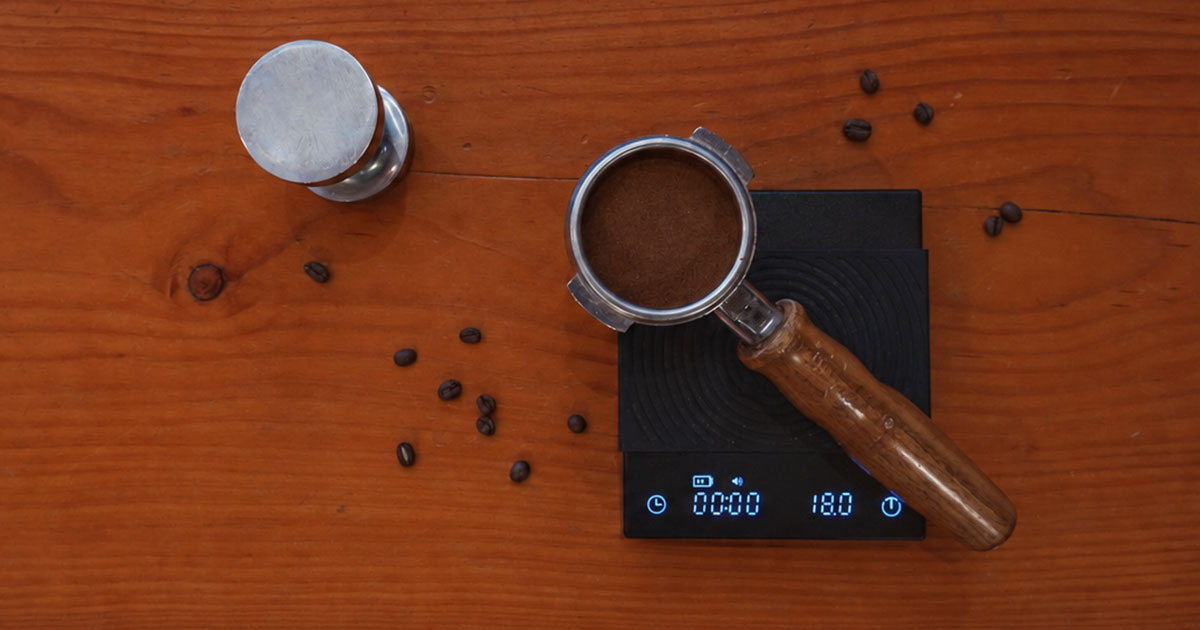
A pound of roasted coffee is about 454 grams. At an 18 gram dose that is roughly 25 double shots, and at the 50 gram per liter range most drip brewers run, close to 48 five-ounce cups. So when one quote comes in 40 cents a pound cheaper, you are choosing between drinks that cost about 1.6 cents less on espresso and under a penny less on drip.
Now the other side of the ledger. A remade drink throws away the coffee, the milk, the cup, the lid, and ninety seconds of a line that is already three deep. One remade latte costs more than a hundred of those penny-and-a-half savings. And a bag that arrives three weeks off roast tastes flat no matter how good your barista is.
Five costs never show up on a quote, and they all move the real number. Freight, where a low per-pound price with paid delivery can beat a higher price delivered. Minimums, which force overbuying and cost you freshness. Waste, meaning coffee dumped at close and shots tossed while someone chases a moving target. Training time, because a week of trial and error every time a bag changes is payroll. And equipment support, which can mean a discount, a referral to a tech, or full in-house service. Any of those works. Finding out mid-rush does not.
Ask for these nine things in writing. Any supplier worth working with answers all of them without stalling.
Run that on two or three suppliers and the cheapest per-pound quote is usually not the cheapest program. Sometimes it is. Either way you will know instead of guessing. If you want the longer version, we wrote about specialty wholesale coffee versus bulk coffee separately.
What about private label and custom blends?
Yes, many wholesale roasters will roast under your label. Private label means the coffee is roasted to your spec and packaged in your bag with your branding. A custom blend means the roaster builds a profile specifically for your shop. Both are common, and both come with minimums.
Private label fits when coffee is part of your brand story and you have the volume to keep a dedicated blend fresh. It does not fit at 15 pounds a week, because a custom roast at that volume means either tiny uneconomical batches or bags sitting long enough to go flat. The minimum protects the coffee, not the upsell.
- What is the minimum per roast, and how often will you roast it?
- Who pays for bag design, printing, and the first print run?
- Do you own the blend recipe, or does the roaster?
- What happens to your remaining bag inventory if you leave?
- Can you start on a stock blend and move to custom later?
That last one is usually the right answer. Run a stock blend for a few months, learn what your customers actually reorder, then build the custom profile around real data instead of a guess. You can see our regular rotation on our shop.
Frequently asked questions about choosing a wholesale coffee supplier
How fresh should wholesale coffee be when it arrives?
Coffee should reach you inside the 7 to 30 day window off roast, ideally in the first half of it. Ask how many days pass between roast day and your delivery, and ask to see the date printed on an actual wholesale bag. If the bag only has a best-by date, you cannot rotate stock properly.
What order minimum should I expect from a wholesale roaster?
Minimums vary widely, and the number matters less than whether it matches your weekly usage. If hitting the minimum means buying three weeks of coffee at a time, the price break is costing you freshness. Ask for the delivery minimum and the price-tier minimum separately, because they are often different.
Do wholesale coffee suppliers provide training?
Good ones do, and it is one of the most valuable things in the agreement. Ask how many hours, whether it is on-site or remote, and whether it covers new hires later or only your opening team. Training you do not pay for is a discount that never appears on the invoice.
Can I get decaf and single-origin coffee from the same wholesale supplier?
Most roasters carry both, but the quality gap between roasters on decaf is larger than most buyers expect. Ask how the decaf is processed, since chemical-free methods like Swiss Water taste noticeably cleaner. Ask which single origins are on right now, not which ones are on the website.
What questions should I ask before switching coffee suppliers?
Ask about roast-to-delivery time, the date printed on the bag, order minimums, delivered cost at your real volume, training, and contract terms. Then ask for samples and run them on your own equipment, with your own water and your own staff. A supplier who hesitates on any of those has told you something.
Choosing well is mostly about asking early
Most bad supplier relationships were predictable. The freshness problem, the minimum that forced overbuying, the training that never materialized: all of it was answerable in the first conversation, and nobody asked because the price sheet looked fine.
Ask the boring questions. Get the roast-to-delivery time in writing, taste the coffee on your own equipment, and compare cost per drink instead of cost per pound. We have been roasting in the Pacific Northwest since 1995 and we work with cafés, restaurants, offices, and grocers across Washington, Oregon, and nationwide. If you want to talk through what your shop actually needs, reach out and we will start with questions, not a quote.
keep reading
Get our latest brewing guide videos


and the stories behind the coffee
in your inbox

Get our latest brewing guide videos and the stories behind the coffee in your inbox

Get free coffee by earning points in the Cutters Point app. Download it here:


Website built by RUSTY GEORGE