

How to Dial In Espresso: A 5-Shot Method for Any New Bag
The quick answer: Dialing in espresso means adjusting your grind and ratio until a bag tastes balanced. Start at 18 grams in, 36 grams out, 25 to 35 seconds. Use your first shot as a baseline, fix the flow rate with grind, then judge sour versus bitter by taste and adjust from there. Most bags land in about five shots.
That's the whole method. The rest of this is how to do it without wasting half a bag.
Here's the thing nobody tells you when you buy your first espresso machine: the machine is not the hard part. Dialing in is. You can own a great grinder, buy great coffee, and still pull four terrible shots in a row because you changed three things at once and have no idea which one helped.
So we're going to change one thing at a time. Five shots, in order, each with one job.
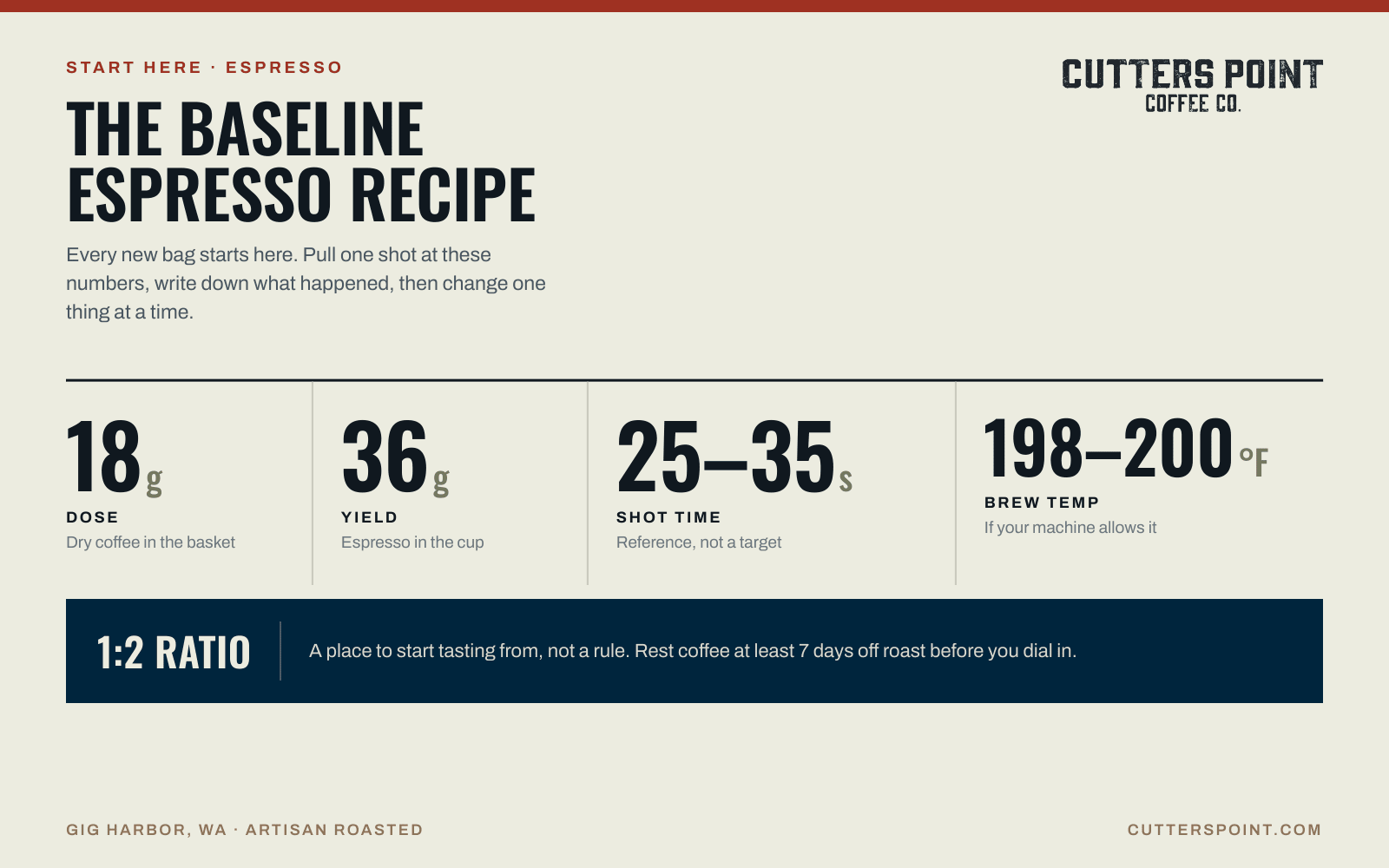
Your starting recipe
- Dose: 18 grams of ground coffee
- Yield: 36 grams of espresso in the cup
- Time: 25 to 35 seconds
- Temperature: 198 to 200°F, if your machine lets you set it
That's a 1:2 ratio. It is not the correct recipe. It's a place to start tasting from.
What does "dialing in" espresso actually mean?
Dialing in is the process of adjusting your grind size and brew ratio until a specific coffee tastes the way you want it to. Every bag is a little different, so the recipe that worked last month won't automatically work on the bag sitting on your counter now.
Two coffees at the same grind setting can pull completely differently. Origin, processing, roast level, and how long ago it was roasted all change how the coffee behaves under pressure. Which is why "what grind setting should I use?" has no real answer, and why a repeatable process beats a number someone handed you on a forum.
What you actually need
Three things, and only three:
- A scale that reads to 0.1 grams. Non-negotiable. Volume is not a measurement in espresso.
- A timer. Your phone is fine. The clock on the machine is fine.
- A grinder you can adjust in small steps. This is the one place worth spending money. Espresso needs finer, more precise adjustment than drip, and a grinder with coarse clicks will fight you every shot.
Nice, not necessary: a bottomless portafilter (you can see problems instead of guessing), a WDT tool (a few needles in a handle, breaks up clumps), and a machine with adjustable temperature.
Worth saying plainly, since it comes up: in our cafés we run La Marzocco Swift grinders. They dose and tamp automatically, which removes two of the biggest sources of shot-to-shot variation. That's great for a bar pulling hundreds of shots a day, and it's also why a café shot can feel more consistent than yours at home. You don't need one. You just need to do by hand what the Swift does automatically: same dose every time, tamped level.
Shot 1: Pull the baseline and write it down
Set your grinder somewhere in the espresso range, dose 18 grams, and pull for 36 grams out. Don't taste it yet. Don't judge it. Just record what happened: grind setting, dose, yield, and time.
This shot exists to give you a starting point, and almost nobody does it. They pull, they grimace, they crank the grinder, they pull again, and four shots later they couldn't tell you where they started. Write it on the bag or in your phone. Two seconds of writing saves you three shots of guessing.
If the shot gushed out in 12 seconds or choked to a drip and gave you 8 grams in 40 seconds, that's fine. That's information. You're about to fix it.
Shot 2: Fix the flow with your grind
Now you're looking at one number: time. Not taste. Time.
At 18 grams in and 36 grams out, you want 25 to 35 seconds.
- Faster than 25 seconds? Grind finer.
- Slower than 35 seconds? Grind coarser.
- Already in range? Skip to shot 3.
Keep your dose at 18 and your yield at 36. Only move the grinder.
Go in small steps. Espresso grind adjustment is unforgiving compared to drip: a change that looks like nothing on the dial can swing your shot ten seconds. If your grinder has clicks, one or two clicks at a time. If it's stepless, a hair. When in doubt, move less than you think you should.
One more thing worth knowing: after you adjust, the grinder still has old coffee sitting in the burrs and chute at the previous setting. Purge a few grams and throw them away, or your "new" setting is really a blend of the old one and the new one. This is the single most common reason people think their grinder isn't doing anything.
You might need two or three passes here. That's normal, and it still counts as shot 2, because you haven't started tasting yet.
Shot 3: Now taste it. Sour or bitter?
Flow is in range. Time to use your mouth.
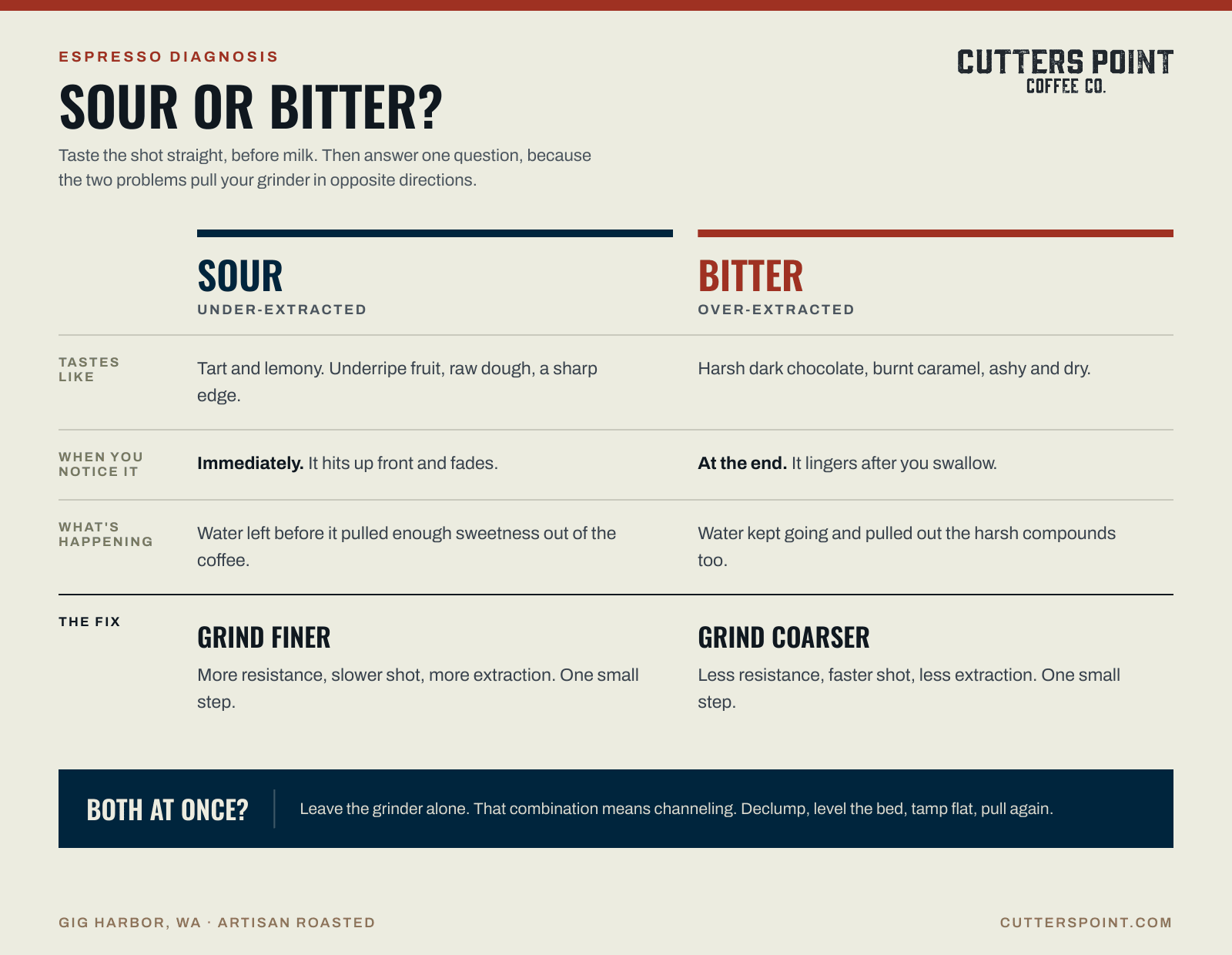
Pull a shot at your working setting and taste it straight, before milk. Milk covers up exactly the things you're trying to diagnose. Then answer one question: is it sour, or is it bitter?
Sour shows up fast and sharp, up front. Tart, lemony, sometimes a bit like underripe fruit or raw dough. That's under-extraction: you haven't pulled enough out of the coffee. Grind finer, back to shot 2's process, one small step.
Bitter shows up at the end and lingers. Dark chocolate gone harsh, burnt caramel, a dry finish that sticks around after you swallow. That's over-extraction. Grind coarser.
Both at once, or sour and dry and harsh all together? Don't touch the grinder. That's usually channeling, where water rushed through cracks and clumps in the puck instead of soaking through it evenly. Part of your puck over-extracted while part barely got wet. Fix your prep instead: break up clumps, level the grounds in the basket, tamp flat. Then pull again with the same setting.
Balanced but thin and boring? Flow is fine, extraction is fine, the recipe just needs stretching. Go to shot 4.
We went deep on the harsh end of this in why your espresso tastes bitter, and on the tart end in how to fix sour espresso shots. If shot 3 sends you clearly one direction, those go further than this post does.
Shot 4: Adjust the ratio, not the grind
Here's where people wreck the progress they just made.
The shot isn't sour and isn't bitter, but it's flat. Or a little harsh at the finish. Or watery. The instinct is to reach for the grinder again. Don't. Your grind is doing its job. Change how much espresso you pull instead.
Keep the grind and the 18 gram dose exactly where they are, and move the yield:
- Thin, weak, washed out? Pull shorter. Try 32 to 34 grams out. Less water, more concentration, more body.
- Heavy, dry, a little harsh on the finish? Pull longer. Try 40 to 42 grams out. More water, softer, sweeter, more forgiving.
Yes, pulling longer usually extracts more, and yes, we just said over-extraction is what makes coffee bitter. Both are true. Ratio and grind are different levers that happen to pull in overlapping directions, which is exactly why you change one at a time and taste.
And 1:2 is a convention, not a law. Some coffees are gorgeous at 1:1.8. Lighter roasts often want 1:2.5 or longer to open up. If the best shot you pull all week is 18 in and 45 out, that's your recipe. The number was never the point.
Shot 5: Lock it in and write it on the bag
By now you should have a shot you'd actually choose to drink. Pull it one more time to confirm it wasn't luck, then write the recipe directly on the bag: grind setting, dose, yield, time.
Do this even though you'll swear you'll remember. You won't. And next week when a shot comes out wrong, having the recipe written down turns a mystery into a two-minute check.
Then stop. Chasing a theoretically better shot is how a good morning turns into six espressos and a headache. The goal was never a perfect shot. It was a coffee you want to drink, repeatable enough that tomorrow morning is easy.
How long should coffee rest before you dial in espresso?
Wait at least 7 days off the roast date. Freshly roasted coffee is still releasing carbon dioxide, and that gas actively fights your extraction. Under pressure it makes the puck foam and churn, so water finds channels instead of soaking through evenly. You'll get gushing shots, wild shot-to-shot swings, and a recipe that's wrong again tomorrow. It's not you. The coffee is still settling.
After about a week, that release slows enough for the coffee to behave predictably. From there, the premium window is roughly 7 to 30 days off roast. That's where our coffees are most stable and where a recipe you dial in on Monday still works on Thursday.
Past 30 days? You can absolutely still pull a delicious shot. Coffee doesn't fall off a cliff at day 31, and anyone telling you it does is selling something. Flavors just get quieter and the sweetness flattens a little. Premium results live in that first month.
One practical note on finding the date. Our bags are printed with a best-by date, set one year from the day the coffee was roasted. So if you want the roast date, subtract twelve months. A bag marked best by June 2027 was roasted in June 2026. Worth doing the math before you blame your grinder for a coffee that's three days old.
Why your dialed-in recipe stops working halfway through the bag
You nailed it on day 8. On day 20 the same setting pulls fast and tastes hollow. You did nothing wrong.
Coffee keeps changing after roasting. As it releases the last of its gas and the oils begin to oxidize, it grinds slightly differently and offers less resistance in the basket. Same dial setting, faster shot. The usual correction is to go one small step finer as a bag ages.
Humidity moves it too. A muggy week and a dry week will genuinely pull differently on identical settings, which is maddening the first time you notice it and reassuring once you know it's real.
And if you're using a grinder that holds onto grounds between doses, some of this morning's shot is actually yesterday's coffee. Purging a gram or two before you dose cleans that up.
None of this means starting over. It means expecting one small nudge every week or so, which is a very different mental game than thinking you've lost the recipe.
When to stop dialing in and change the coffee
There's a point where the grinder isn't the problem.
If you've worked the whole method, the flow is right, the prep is clean, and every adjustment makes the shot different but none of them make it better, you may be trying to get something out of this coffee that it doesn't have. Dialing in reveals what a coffee is. It can't turn it into a different coffee.
That's not failure, it's just preference. Some people want deep and roasty. Some want caramel, chocolate, and sweetness without the harsh edge. If you're in the second camp and fighting a dark roast every morning, the fastest fix isn't another shot. It's a different bag.
Our Discovery Espresso was built for exactly this: dark caramel, toasted almond, a little fruit sweetness, and a full silky body that holds up in milk without turning bitter. It's a forgiving coffee to dial in, which makes it a good one to learn this method on.
Frequently asked questions
How many shots does it take to dial in espresso?
Usually four to six if you change one variable at a time. It can take a dozen or more if you adjust grind, dose, and yield all at once, because you never learn which change did what.
Can you dial in espresso without a scale?
Not reliably. Dose and yield are the two numbers the whole method rests on, and eyeballing them means you're guessing. A basic 0.1 gram scale is the cheapest meaningful upgrade in espresso.
Does grind size matter more than dose?
Grind is the more powerful lever and the one you should adjust first. Dose is better left fixed at 18 grams while you learn, so you have a stable reference point.
How fine is too fine for espresso?
When the shot chokes, drips, or takes more than 35 to 40 seconds to reach your target yield, you've gone too far. Extremely fine grinds also make channeling worse, so a bitter and sour shot at once is often a sign to back off.
Do I need to dial in every new bag?
Yes, though it gets fast. Once you know your machine, a new bag of a familiar coffee usually takes one or two shots.
Why does espresso taste better at a café?
Commercial grinders, constant throughput so the beans in the hopper are always fresh, filtered water, and equipment that gets cleaned every single day. The recipe is often the easy part.
keep reading
Get our latest brewing guide videos


and the stories behind the coffee
in your inbox

Get our latest brewing guide videos and the stories behind the coffee in your inbox

Get free coffee by earning points in the Cutters Point app. Download it here:


Website built by RUSTY GEORGE